Well, the journey is over. My fate has been decided and all my options have been exhausted. This afternoon I received in the mail an offer to study at William & Mary in the fall. In a way, I was expecting an acceptance because I was first on the waiting list and so it only took one person to turn down their initial offer for me to be bumped up. It's hard to believe that after all these months of stressing out over William & Mary's admissions, applications, thank you letters, e-mails, visits, and phone calls, I am still content with my decision to study at South Florida. It seems almost like a dream that happened yesterday where I was so confident that Williamsburg was my destiny, but for some reason events had me accepting an offer in Tampa.
It is also not lost on me that this is the exact same situation I was in four years ago, perhaps to the day. Then, I wanted to attend Chapel Hill and had my mind set to it. I was confident I would get in and became very excited about the prospect of studying at an elite university. I was first deferred then rejected, and "settled" for UNCW. Within a year at Wilmington I knew that I had been rejected from UNC for a reason. My home was here. I began to see the differences between the prospects of attending a huge university and studying at a smaller, growing campus. By my second year, I was convinced that UNCW was the right place to end up. To this day, I tell anyone who asks that I was lucky to get rejected from UNC. I would never have had the opportunity to lead a rowing team, write for the school newspaper, excel in two majors, and spend a month in Central America among 3,000 year old ruins.
My experience with applying to undergraduate actually played a major role in my decision to study at South Florida. William & Mary is an elite university, the oldest one in the country, and their anthropology department is perhaps the top program for historical archaeology on the East Coast. But they cannot offer me any sort of assistantship or financial aid, and I feel that my opportunities would be limited, as there is no one on the faculty that works in Central America. University of South Florida is located in a beautiful state in one of the biggest cities in the country. They are able to offer me financial aid and I'm almost guaranteed the chance to study again in Central America. The choice for me is clear. While USF may not be as prestigious as William & Mary, I know Tampa is where I belong. I don't doubt for one minute that a year from now I'll be regretting my decision.
Monday, April 11, 2005

Sunday, April 10, 2005
Dialogue
This past Friday we had yet another interesting 50 minutes in my Philosophy 101 class. While the meeting began as strictly in the context of philosophers like Sartre and Buber, it eventually progressed into a discussion on the contemporary issue of the role of dialogue in the "war on terrorism."
What McGowan (the instructor) was advocating was constantly striving for dialogue with those who are "out to get" the United States. Although this may never be achieved, we must avoid concluding that it can't. In other words, while he advocates peace and non-violence, he seemed to suggest that our current situation is a necessary evil. McGowan continued by saying, unambiguously, that we as Americans have no grounds on which to condemn terrorists or their actions, including the 9/11 hijackers. Needless to say, at least one student took offense and cited her faith in God as reason enough to condemn terrorist acts. I think McGowan's methodology was lost on many students when he pursued the issue and used the "but why not?" line of questioning when challenging her. He eventually backed off a little bit and revealed that he was trying to get us to think, which is where he excels as a professor (purposefully enrage students in order to get them to think). After the class meeting, I started having second thoughts about all the perceived liberal bias in academia. At least in this case, McGowan was advocating an extreme view on terrorism in order to get us, as students of philosophy, to think.
While I didn't take offense at McGowan's comments and agreed with him to an extent, I echoed the "war-as-necessary-evil" argument but stopped short of suggesting that terrorists are justified in their acts of violence. Indeed, I believe that their basic argument, while completely wrong on moral grounds, is valid. What McGowan was doing was completely removing the emotional/political/moral aspect of terrorism vs. the United States and challenging us to approach the other side in an objective manner. While this method is rejected by many people as impossible, McGowan's overarching argument is that in order to achieve the desired result (i.e. peace) we have to constantly strive for dialogue with our enemies, regardless of whether or not it seems impossible. I agree with him in that if we continue as we are, the United States will ultimately fail at winning the war on terror.
On a personal level, I can't think of a single more important concept than dialogue. Everything we do in life, every aspect of our existence, is governed by the idea that we are able to interact with those around us. Even the most reclusive hermit is influenced in his ways by the outside world. For this reason, it seems ridiculous to assume that anyone can progress through life by ignoring the ideas of others and not considering all reasonable options. In terms of my Art of Living, I have begun to incorporate dialogue into my everyday existence, the most significant manifestation of that being discussions via the internet. From reading blogs to posting my own thoughts on message boards, not only am I giving my opinion but I am nurturing and informing it at the same time. I am constantly disheartened at the amount of stubbornness that dominates many people's thought process, sometimes to the point of complete ignorance. While it is not my place to judge anyone for the way they think, I can only hope that science and reason will prevail in the end.
What McGowan (the instructor) was advocating was constantly striving for dialogue with those who are "out to get" the United States. Although this may never be achieved, we must avoid concluding that it can't. In other words, while he advocates peace and non-violence, he seemed to suggest that our current situation is a necessary evil. McGowan continued by saying, unambiguously, that we as Americans have no grounds on which to condemn terrorists or their actions, including the 9/11 hijackers. Needless to say, at least one student took offense and cited her faith in God as reason enough to condemn terrorist acts. I think McGowan's methodology was lost on many students when he pursued the issue and used the "but why not?" line of questioning when challenging her. He eventually backed off a little bit and revealed that he was trying to get us to think, which is where he excels as a professor (purposefully enrage students in order to get them to think). After the class meeting, I started having second thoughts about all the perceived liberal bias in academia. At least in this case, McGowan was advocating an extreme view on terrorism in order to get us, as students of philosophy, to think.
While I didn't take offense at McGowan's comments and agreed with him to an extent, I echoed the "war-as-necessary-evil" argument but stopped short of suggesting that terrorists are justified in their acts of violence. Indeed, I believe that their basic argument, while completely wrong on moral grounds, is valid. What McGowan was doing was completely removing the emotional/political/moral aspect of terrorism vs. the United States and challenging us to approach the other side in an objective manner. While this method is rejected by many people as impossible, McGowan's overarching argument is that in order to achieve the desired result (i.e. peace) we have to constantly strive for dialogue with our enemies, regardless of whether or not it seems impossible. I agree with him in that if we continue as we are, the United States will ultimately fail at winning the war on terror.
On a personal level, I can't think of a single more important concept than dialogue. Everything we do in life, every aspect of our existence, is governed by the idea that we are able to interact with those around us. Even the most reclusive hermit is influenced in his ways by the outside world. For this reason, it seems ridiculous to assume that anyone can progress through life by ignoring the ideas of others and not considering all reasonable options. In terms of my Art of Living, I have begun to incorporate dialogue into my everyday existence, the most significant manifestation of that being discussions via the internet. From reading blogs to posting my own thoughts on message boards, not only am I giving my opinion but I am nurturing and informing it at the same time. I am constantly disheartened at the amount of stubbornness that dominates many people's thought process, sometimes to the point of complete ignorance. While it is not my place to judge anyone for the way they think, I can only hope that science and reason will prevail in the end.
Tuesday, April 05, 2005
Self-evaluation
Here is the brief self-evaluation I was asked to write for my Philosophy 101 course. I think it makes a swell blog entry as well because it may provide insight to why many of my posts are the way they are.
Although a critical evaluation of the current state of academia will be avoided, it is worth noting that my recent awareness of the matter has led me to conclude a major point: A tremendous effort must be made on the part of the student to meticulously scrutinize and evaluate the information being presented in a university course in order to receive a well-rounded, quality education, particularly in the humanities and social sciences. A course in existential philosophy could not have come at a better time for me.
Overall, I am pleased with my progress over the past semester. I have not missed any meetings and I manage to consistently turn in what I feel are quality papers. The nature of the course has caused me to take an active interest in the material and truly reflect on the topics, making paper writing effortless and enjoyable. Consequently, I feel that I have produced some of my best essays in all of my four years at UNCW. This has to do with that fact that I believe philosophical thinking should (and does in this case) go beyond a simple academic study of the topic. The paper topics are such that they require us to think for ourselves and apply the concepts and themes to our own lives; something that I feel is not stressed enough in undergraduate coursework.
While my performance in the course thus far has been nothing less than what I normally expect of myself, the unorthodox class format and teaching style has made me aware of the importance of constant self-evaluation and inner reflection. This is in contrast with the typical university course where grades and minimum requirements are emphasized over the benefits of a more personal, reflective approach to higher learning. The result is usually a detached, unimpassioned approach to education on the part of the student. Over the past semester, I have taken full advantage of the class format and used it to my benefit. I don't have to worry about attendance, due dates, participation grades, quiz grades, multiple choice exams, group work, PowerPoint presentations, or getting the right answer. While some of these are important to the class, the point is that I don't have to worry about them. As for getting the right answer, I have learned that there is no right answer in philosophy. That is the beauty of this course and the reason why I feel I have been enjoying it so much.
Over the past four months, I have experienced a metamorphosis in the way I think about and view the world. This change, I feel, has much to do with the material covered in Philosophy 101. I believe that the format of the class has allowed me to not only learn about existential philosophy from an academic standpoint, but to apply existential concepts and themes to my own world. I have rejected many of the more extreme philosophies, such as nihilism and other overemphasis on death and despair. Conversely, I have embraced Heidegger's discussions of conscious awareness of death as the key to understanding and appreciating the nature of our existence. Although I have yet to fully grasp the intricacies of many of the philosophies discussed in class, they have made me realize that there is far more to life than simply existing.
In conclusion, I am very satisfied with my performance in the course given the limits of undergraduate coursework, such as brief fifty-minute sessions and a consideration for other courses. My only regret is that I didn't have enough time to fully immerse myself in the worlds of Heidegger, Husserl, Sarte, Kierkegaard, and others. I got feeling that these fellows has massive amounts of time on their hands to not only produce the work they did, but to synthesize and reflect on it in the first place. I am envious to say the least.
Saturday, April 02, 2005
The Turtle
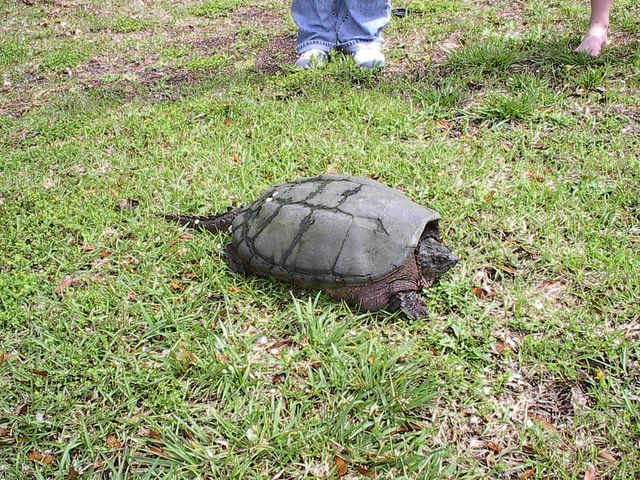
There was a massive snapping turtle outside of my apartment this afternoon. I noticed it when I was driving to the store and thought it was fake at first because it was hardly moving. When I returned, he had walked about fifteen yards toward the road so I got Angela, and walked over to the next building and told Meredith to come out as well. The image above could just as well be a video clip because he didn't move at all while we were looking at him. We were afraid that the turtle would wander into the road, but an hour or so later he was gone, hopefully back to his home.
Thursday, March 31, 2005
The Next Step
My entire future was just decided in the past five minutes. I received in the mail today the unofficial acceptance letter from U. of South Florida to their Public Archaeology MA program. Yesterday I had received an e-mail from U. of South Carolina offering me $10,000/year though an assistantship and tuition waiver. No word yet from William & Mary on whether or not I'm off the waiting list.
Five minutes ago, I just made one of the biggest decisions of my life. One that will shape who I am, who I become as a person, and how I think. It's the last one that makes such a decision so hard.
So, a few minutes ago I had my USF acceptance letter in one hand and my cell phone in the other with the graduate director's phone number entered and ready to dial. I took a deep breath, closed my eyes, and once again imagined myself at each school. I can honestly say it was the first time in my entire life flashed before my eyes. I opened my eyes and stared at the letter some more. "This is it," I thought. I put my phone down, stood up, and paced my room twice. Outloud, I said "Fuck it" and picked my phone back up and dialed USF. I left a message on the director's voice mail that I plan on attending in the fall.
Tampa, here I come.

Five minutes ago, I just made one of the biggest decisions of my life. One that will shape who I am, who I become as a person, and how I think. It's the last one that makes such a decision so hard.
So, a few minutes ago I had my USF acceptance letter in one hand and my cell phone in the other with the graduate director's phone number entered and ready to dial. I took a deep breath, closed my eyes, and once again imagined myself at each school. I can honestly say it was the first time in my entire life flashed before my eyes. I opened my eyes and stared at the letter some more. "This is it," I thought. I put my phone down, stood up, and paced my room twice. Outloud, I said "Fuck it" and picked my phone back up and dialed USF. I left a message on the director's voice mail that I plan on attending in the fall.
Tampa, here I come.
Wednesday, March 30, 2005
Aspects
Over the past several weeks I've become more and more aware of my Art of Living. That is to say that I am beginning to realize the constituent parts that combine to form the structure of how I operate on a daily basis. This, I believe, is the most important step in making any art of living work for you. We can aspire to always tell the truth, never make assumptions, or be kind to others but in order for those things to take full effect we must really stand back and look at ourselves from a different perspective. One has to consider the consequences, both positive and negative, of applying a new aspect to an art of living. In other words, it is one thing to say you're going to do something to better yourself but it is another to truly make it work on a fundamental level. If you never contemplate the ramifications of fine-tuning your art of living how are you going to grow intellectually and emotionally, if those are your ultimate goals?
What I think will help me, and what I'm surprised I haven't done yet, is to list the major aspects of my art of living. A nice, concise list of what it is that guides me through the hours of my day, the days of my weeks, and the weeks of my years, and the years of my life. Dr. Phil would be proud.
Aspects of My Art of Living (in no particular order)
What I think will help me, and what I'm surprised I haven't done yet, is to list the major aspects of my art of living. A nice, concise list of what it is that guides me through the hours of my day, the days of my weeks, and the weeks of my years, and the years of my life. Dr. Phil would be proud.
Aspects of My Art of Living (in no particular order)
- Always tell the truth.
- Read.
- Listen.
- Don't worry about what other people think about you.
- Realize and appreciate when you're better than someone else.
- Realize and appreciate when someone else is better than you.
- Keep your word.
Tuesday, March 29, 2005
The Third Agreement
Here is an excerpt from my philosophy paper on Don Miguel Ruiz's The Four Agreements, A Toltec Wisdom Book. Agreements three is "don't make assumptions."
To not make assumptions seems to go against the very nature of humanity, but by consciously avoiding unwarranted judgement we not only eliminate seeds of hate and bias but also facilitate the growth of understanding, kindness, and a plurality of meaningful arts of living. Too often we read and hear about negative events that could have easily been avoided had only we opened our minds to a deeper level of understanding. I am reminded of the recent case involving Terri Schivo, a woman whose vegetative state resulted in a divided family. From every direction came assumptions, judgements, accusations, and falsities that resulted in this very unfortunate situation becoming a national embarrassment. Reputable news agencies abandoned any remnants of journalistic integrity by openly speculating on the motivations of those involved. Unsubstantiated reports continue to saturate the airwaves and news presses. Does Terri Schivo's husband want her dead so he can marry his girlfriend? Do her parents want her alive for purely political and religious reasons? The assumptions resulting from such speculative news reporting has the adverse side effect of perpetuating a slow moral decline in the United States. Since major news outlets bombard us with stories on a daily basis, over time we are desensitized to the fact that making assumptions only negates any reasonable and moral art of living.
Saturday, March 26, 2005
Books
I am in a literal utopia at the moment (yes that was pun...my apologies). I found myself back at Edward McKay tonight, a paradise for nonfiction bookworms such as myself. Each time I browse this used bookstore I am amazed at the quality of their science, anthropology, and nature sections. Apparently Winston-Salem lacks the same taste in books as me. With a grant from the Bank of Mother I acquired two Wade Davis volumes, One River and Shadows in the Sun, Lost World by Tom Koppel, and a slightly tattered collection of Henry David Thoreau writings. All in all a source of intellectual stimulation that is sure to last me through the summer.
I am most excited about One River by Wade Davis. A Harvard-trained ethnobotanist, Davis is an authority on Amazonian plants and psychotropic drugs. I didn't know where I had heard his name before, but after I had bought the book I realized that he was recommended by my fellow anthropology and environmental nut Hollis. A hero for "psychonauts" as their called, Davis seems to be a respected and accomplished scientist and scholar of indigenous plant use. Only having read the introduction and first few pages of the first chapter, I can see why his work has received so much acclaim. It's very easy to read and already very interesting. Coming of the heels of White Rock by Hugh Thompson and Heinrich Harrier's Seven Years in Tibet, my current interest lies in travel writing with a bit of anthropology or science involved if I'm lucky.
I only read the prologue of Davis' Shadows in the Sun but it's in the same genre as One River: a very personal account of indigenous cultures and how they still possess what most of us have lost in the torrent of modernization. I can see some dismissing Davis' work as perpetuating the demonizing of Western society and how indigenous cultures are somehow "better" than us. On the surface this may seem true but my impression of Davis so far is that he is able to relate in writing what many of us think of as exotic or pristine. I'm anxious to delve into both of these books, perhaps simultaneously, in order to gain a better understanding of the earth that we're all a part of but that only a few remaining cultures truly understand.
Lost World by Tom Koppel caught my attention because it is an argument for a maritime origin of the first Americans. The long-standing paradigm has the peopling of North America occurring via the Bering Land Bridge between Siberia and Alaska. Koppel, along with a still-growing community of archaeologists, are positing this maritime hypothesis. Citing the lack of archaeological sites due to increased sea levels since the last Ice Age, Koppel aims to lay out the theory. I am the audience he is addressing, as I was taught the traditional Land Bridge theory in my anthropology classes so I will approach this work with an open and eager mind. Damnit I love knowledge!
To me a book is much more than bound paper infused with ink. It's a key, a microscope, a window, and a mirror all at the same time. I look for books that will leave me with more questions than when I started. I gain knowledge with each page turned, but the true beauty of a good book is its ability to send my mind racing in a million directions at once, as if my brain were the victim of the old torturing method known as "quartering." A good book makes me look closer at the world around me. Things really aren't quite what they seem. A volume that challenges and expands my view of reality is what I crave. A window to a world that otherwise is invisible is a gift that I cannot dismiss as mere paper, ink, and glue. Through that window I see not only fascinating places and experiences but myself as well, staring back at me from the pages. A strange dynamic is in motion when I read a good book. I'm starting to see the genius behind the philosophy of the PBS show Reading Rainbow:
I am most excited about One River by Wade Davis. A Harvard-trained ethnobotanist, Davis is an authority on Amazonian plants and psychotropic drugs. I didn't know where I had heard his name before, but after I had bought the book I realized that he was recommended by my fellow anthropology and environmental nut Hollis. A hero for "psychonauts" as their called, Davis seems to be a respected and accomplished scientist and scholar of indigenous plant use. Only having read the introduction and first few pages of the first chapter, I can see why his work has received so much acclaim. It's very easy to read and already very interesting. Coming of the heels of White Rock by Hugh Thompson and Heinrich Harrier's Seven Years in Tibet, my current interest lies in travel writing with a bit of anthropology or science involved if I'm lucky.
I only read the prologue of Davis' Shadows in the Sun but it's in the same genre as One River: a very personal account of indigenous cultures and how they still possess what most of us have lost in the torrent of modernization. I can see some dismissing Davis' work as perpetuating the demonizing of Western society and how indigenous cultures are somehow "better" than us. On the surface this may seem true but my impression of Davis so far is that he is able to relate in writing what many of us think of as exotic or pristine. I'm anxious to delve into both of these books, perhaps simultaneously, in order to gain a better understanding of the earth that we're all a part of but that only a few remaining cultures truly understand.
Lost World by Tom Koppel caught my attention because it is an argument for a maritime origin of the first Americans. The long-standing paradigm has the peopling of North America occurring via the Bering Land Bridge between Siberia and Alaska. Koppel, along with a still-growing community of archaeologists, are positing this maritime hypothesis. Citing the lack of archaeological sites due to increased sea levels since the last Ice Age, Koppel aims to lay out the theory. I am the audience he is addressing, as I was taught the traditional Land Bridge theory in my anthropology classes so I will approach this work with an open and eager mind. Damnit I love knowledge!
To me a book is much more than bound paper infused with ink. It's a key, a microscope, a window, and a mirror all at the same time. I look for books that will leave me with more questions than when I started. I gain knowledge with each page turned, but the true beauty of a good book is its ability to send my mind racing in a million directions at once, as if my brain were the victim of the old torturing method known as "quartering." A good book makes me look closer at the world around me. Things really aren't quite what they seem. A volume that challenges and expands my view of reality is what I crave. A window to a world that otherwise is invisible is a gift that I cannot dismiss as mere paper, ink, and glue. Through that window I see not only fascinating places and experiences but myself as well, staring back at me from the pages. A strange dynamic is in motion when I read a good book. I'm starting to see the genius behind the philosophy of the PBS show Reading Rainbow:
Butterfly in the skyApplicable today as it was then. Dismiss it as silly, but that song (and way of thinking) has taken on a new meaning for me. Thanks Levar.
I can go twice as high
Take a look
It's in a book
A Reading Rainbow
I can go anywhere
Friends to know
And ways to grow
A Reading Rainbow
I can be anything
Take a look
It's in a book
A Reading Rainbow
A Reading Rainbow
Friday, March 25, 2005
This Just In
Seems like I haven't written in ages...but it's only been three days. I've been enthralled by what some call "the blogosphere," more specifically the political blogosphere. Starting a few months ago, I began reading some political websites on a regular basis, mostly Frontpagemagazine.com, an overtly (and sometimes annoyingly) conservative site mast headed by David Horowitz, author of the Academic Bill of Rights and the leader of the so-called "Academic Freedom movement" on college campuses across the US. It amuses me how riled up conservatives get about issues ranging from Marxism in academia to the horror of Terri Schivo being "starved" to death.
To balance out my conservative opinion intake, I began reading the online version of the Socialist Worker, the publication of the International Socialist Organization. Needless to say, these two sites are on quite opposite extremes of the political spectrum. I found myself fascinated by socialist thought as espoused on the Socialist Worker website but still rejected most of their ideas about how the country should be run. It is only updated once every few weeks and much of their material is tired and recycled issues (e.g. kill the Bush war machine). I did, however, see the parallel between that aspect of socialism and the staunch conservatism of Horowitz and Frontpagemagazine.com. The Nation is another online version I've started to read consistently. Knowing it to have a very progressive agenda, I was attracted to The Nation by its slogan ("Unconventional Wisdom Since 1865") and original mission statement, which they still adhere to. There is a professor in Bear Hall (home of the Philosophy and Religion, Mathematics, and Computer Science departments) with the famous George W. Bush-as-Alfred E. Neuman parody cover taped on his office door. Try putting a John Kerry or Bill Clinton parody drawing on your door and see how long it lasts in hallways of academia.
Perhaps my favorite political blog is written by Kevin Drum and titled The Washington Monthly. It seems to be one of the most unbiased, observational, and insightful opinion publications out there, blog or otherwise. If John Stewart wrote a blog, it would probably read like this one. So, while based on opinion, I find myself getting a large portion of my political news from Kevin Drum and his blog. I have only very recently started reading a couple of blogs written by two PhD candidates and their experiences. I haven't read enough of them yet to have an informed opinion, but they are entertaining nonetheless.
My new found interest in the world of politics on the internet can be attributed to my conclusion that popular media is shit. I have become disillusioned with cable news, network news, popular newspapers, local news, news magazines, etc. They all spew the same sensationalist garbage aimed at a public with the attention span of my aging cat and the intellect of his feces. Popular media does not give the American public the credit they deserve, so we fall into this trap of thinking that Terri Schivo and Michael Jackson are actually important news stories. It is a self-perpetuating cycle of instant gratification: news agencies want to be the first to break the story and in the process completely trample over any notion of journalistic integrity. Waiting on the other side is a willing public anxious to eat up the latest garbage as if it were actually worth something. What the public at large does not realize is that these news networks and corporations thrive on deceiving the public into thinking what they are reporting is truly important. Turn on Fox News, CNN, or even one of the big networks, or open up a Newsweek magazine and count how many stories you would consider important news. There was once a fine line between Entertainment Tonight and the nightly news, but that line has since disappeared.
So, after coming to the above realization and deciding that I did not want to live my life as a corporate bitch, I decided to venture out on my own to get my news from where I wanted to get it, as opposed to being spoon fed glossy stories and opinion-laden news reports. The internet has made that possible and its one saving grace. Computers are no longer just porn boxes and music-stealing machines but can now provide access to important information from around the world that can shape or destroy public and personal opinion.
To balance out my conservative opinion intake, I began reading the online version of the Socialist Worker, the publication of the International Socialist Organization. Needless to say, these two sites are on quite opposite extremes of the political spectrum. I found myself fascinated by socialist thought as espoused on the Socialist Worker website but still rejected most of their ideas about how the country should be run. It is only updated once every few weeks and much of their material is tired and recycled issues (e.g. kill the Bush war machine). I did, however, see the parallel between that aspect of socialism and the staunch conservatism of Horowitz and Frontpagemagazine.com. The Nation is another online version I've started to read consistently. Knowing it to have a very progressive agenda, I was attracted to The Nation by its slogan ("Unconventional Wisdom Since 1865") and original mission statement, which they still adhere to. There is a professor in Bear Hall (home of the Philosophy and Religion, Mathematics, and Computer Science departments) with the famous George W. Bush-as-Alfred E. Neuman parody cover taped on his office door. Try putting a John Kerry or Bill Clinton parody drawing on your door and see how long it lasts in hallways of academia.
Perhaps my favorite political blog is written by Kevin Drum and titled The Washington Monthly. It seems to be one of the most unbiased, observational, and insightful opinion publications out there, blog or otherwise. If John Stewart wrote a blog, it would probably read like this one. So, while based on opinion, I find myself getting a large portion of my political news from Kevin Drum and his blog. I have only very recently started reading a couple of blogs written by two PhD candidates and their experiences. I haven't read enough of them yet to have an informed opinion, but they are entertaining nonetheless.
My new found interest in the world of politics on the internet can be attributed to my conclusion that popular media is shit. I have become disillusioned with cable news, network news, popular newspapers, local news, news magazines, etc. They all spew the same sensationalist garbage aimed at a public with the attention span of my aging cat and the intellect of his feces. Popular media does not give the American public the credit they deserve, so we fall into this trap of thinking that Terri Schivo and Michael Jackson are actually important news stories. It is a self-perpetuating cycle of instant gratification: news agencies want to be the first to break the story and in the process completely trample over any notion of journalistic integrity. Waiting on the other side is a willing public anxious to eat up the latest garbage as if it were actually worth something. What the public at large does not realize is that these news networks and corporations thrive on deceiving the public into thinking what they are reporting is truly important. Turn on Fox News, CNN, or even one of the big networks, or open up a Newsweek magazine and count how many stories you would consider important news. There was once a fine line between Entertainment Tonight and the nightly news, but that line has since disappeared.
So, after coming to the above realization and deciding that I did not want to live my life as a corporate bitch, I decided to venture out on my own to get my news from where I wanted to get it, as opposed to being spoon fed glossy stories and opinion-laden news reports. The internet has made that possible and its one saving grace. Computers are no longer just porn boxes and music-stealing machines but can now provide access to important information from around the world that can shape or destroy public and personal opinion.
Tuesday, March 22, 2005
You can take a boy out of the city...
I've been consumed recently by political stuff; mostly the Terri Schivo issue that I've concluded is a huge embarrassment to the United States government and its leaders. Perhaps I'm more politically conscious, but I can honestly say this is the first time I'm ashamed to be represented by the current government. I shan't write on it again but what I will say is that using the misfortune and heartache of an American family to push a religious and political agenda is sad and disturbing and not part of my Art of Living.
Not to be absolutely certain is, I think, one of the essential things in rationality.
--Bertrand Russell
Other than that, what's been on my mind recently is my future. I've now been accepted by two of my three graduate schools, with the third still in limbo. After thinking about it at length, if the choice does come down to William & Mary and U. of South Florida I'm leaning toward the latter. Although W&M has been my first choice for a long time, I have to get over the whole prestige kick that I've been on and wake up. It would be silly of me to choose an institution JUST because it is more prestigious than another. While W&M is older and more "traditional", I feel that I would have more opportunity at USF and almost a guaranteed chance to study the Maya and perhaps go back to Central America. There are no Mayanists at W&M at all and thus a very slim chance that I would get to work down there for my master's. As a result, I should choose the school that would be better for my future overall. Besides, the hard part is over. I've been accepted to a program above undergraduate, and it seems that much less emphasis is placed on WHERE I get my master's versus the quality or relevance of my work in terms of going on to a doctoral program. Simply put, brand names aren't important in post-undergraduate academia.
Two roads diverged in a wood, and I--
I took the one less traveled by,
And that has made all the difference.
--Robert Frost
The real issue that's eating at me is what I'm going to be leaving if I end up in Tampa. I have grown to love Wilmington as my home and the place that has shaped me into the person I am now. The town has provided me with so much that I almost feel guilty leaving it, like I used it for four years and now I'm abandoning it. But I know that's not true, because a part of the Port City will be with me always. I've have learned that I almost have to live near a large body of water. Wilmington has the Cape Fear River and the Atlantic Ocean. I've gotten used to the feeling that I'm literally on the edge of the world. It's comforting to know that if things get too much, I can jump off and swim into the sunset where nobody is. It's nice to have an escape plan like that.
I'm also leaving one of the few things in my life right now that really does matter, when all is said and done. I was prompted to write this entry because I made the decision that when I move away, I'm not ready to move on. I value the moments we have now because they give me the opportunity to be free and escape from a universe that is too often centered around me. When I'm fourteen hours away such a connection is much harder but I'm not willing to let it go right now. Being apart, while hard, is going to make me stronger and motivate me to continue my quest to de-center myself from reality and realize that I'm not the only important person after all. She helps me do that on a regular basis and it is that that I'm going to miss the most.

Not to be absolutely certain is, I think, one of the essential things in rationality.
--Bertrand Russell
Other than that, what's been on my mind recently is my future. I've now been accepted by two of my three graduate schools, with the third still in limbo. After thinking about it at length, if the choice does come down to William & Mary and U. of South Florida I'm leaning toward the latter. Although W&M has been my first choice for a long time, I have to get over the whole prestige kick that I've been on and wake up. It would be silly of me to choose an institution JUST because it is more prestigious than another. While W&M is older and more "traditional", I feel that I would have more opportunity at USF and almost a guaranteed chance to study the Maya and perhaps go back to Central America. There are no Mayanists at W&M at all and thus a very slim chance that I would get to work down there for my master's. As a result, I should choose the school that would be better for my future overall. Besides, the hard part is over. I've been accepted to a program above undergraduate, and it seems that much less emphasis is placed on WHERE I get my master's versus the quality or relevance of my work in terms of going on to a doctoral program. Simply put, brand names aren't important in post-undergraduate academia.
Two roads diverged in a wood, and I--
I took the one less traveled by,
And that has made all the difference.
--Robert Frost
The real issue that's eating at me is what I'm going to be leaving if I end up in Tampa. I have grown to love Wilmington as my home and the place that has shaped me into the person I am now. The town has provided me with so much that I almost feel guilty leaving it, like I used it for four years and now I'm abandoning it. But I know that's not true, because a part of the Port City will be with me always. I've have learned that I almost have to live near a large body of water. Wilmington has the Cape Fear River and the Atlantic Ocean. I've gotten used to the feeling that I'm literally on the edge of the world. It's comforting to know that if things get too much, I can jump off and swim into the sunset where nobody is. It's nice to have an escape plan like that.
I'm also leaving one of the few things in my life right now that really does matter, when all is said and done. I was prompted to write this entry because I made the decision that when I move away, I'm not ready to move on. I value the moments we have now because they give me the opportunity to be free and escape from a universe that is too often centered around me. When I'm fourteen hours away such a connection is much harder but I'm not willing to let it go right now. Being apart, while hard, is going to make me stronger and motivate me to continue my quest to de-center myself from reality and realize that I'm not the only important person after all. She helps me do that on a regular basis and it is that that I'm going to miss the most.
Subscribe to:
Posts (Atom)